 Skip to content

Scissor Lifts vs. Scaffolding: Making the Right Choice for Your Worksite
Scaffolding and scissor lifts are among the most commonly used types of equipment for working at heights. Despite each having its own advantages and disadvantages, the choice of equipment should primarily be guided by the goals of the work, worker safety considerations, and economic efficiency. Below, we’ll explore the benefits of hiring scissor lifts over building scaffolds by examining the strengths and weaknesses of both.
Scissor Lifts

Scissor lifts include folding mechanisms from a system of supports in the form of a pantograph. They are designed for the safe lifting and movement of workers at height. According to OSHA requirements, lift operators must undergo appropriate training and certification.
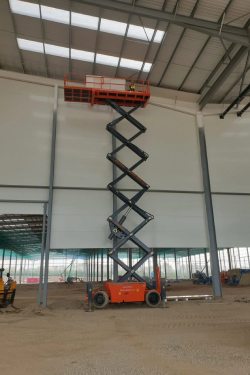
Scissor lifts are a compact design ready to work immediately upon arrival at the construction site. Their use significantly reduces the time spent on construction work, as these devices promptly deliver workers and loads precisely where needed. The lifts ensure the safety of transported materials or personnel by moving very smoothly. At the end of the workday, the equipment is moved to the hangar, thus not disrupting the aesthetics of the facade. Any emergency situation is automatically prevented by a special system that immediately stops the equipment. This ensures complete safety during work. Working on scaffolds cannot guarantee you the same level of safety.
Scissor lifts are in high demand across various industries. They are used for finishing and facade work, installing various structures, at shipyards, warehouses, in construction and more.
Scaffolding
Scaffolds are temporary structures that, when assembled, form a working platform for various tasks at height. According to OSHA requirements, for the safe use of scaffolds, there must be guardrails and fall protection systems (when working at heights of 10 feet or more). Scaffold components must withstand a load four times greater than their maximum intended load.
Overall, building scaffolds have stood the test of time as a simple and accessible means of working at height. However, progress has long been able to offer us more convenient and efficient solutions, so the heyday of scaffolds is gradually fading away.
Advantages of Scissor Lifts over Scaffolding
Preparation
A lot of effort and time is spent on transporting and assembling scaffolds. On the other hand, scissor lifts have a wheelbase and are ready to work from the first minute on the site. The device has a relatively small weight, so it can be easily transported from one object to another. Add to this the self-levelling function and all-terrain tires, and you get a compact and versatile mechanism for efficient work at height.
Performance
To lift loads using scaffolds, special mechanical devices are required, leading to additional efforts and costs. Scissor lifts have a lifting capacity of 100 to 750 kg and can provide smooth and safe lifting of both loads and workers to the required height. Since it can lift both people and materials, there is no need to use additional equipment. Loading and unloading of materials are greatly simplified since the platform can descend almost to the ground.
Flexibility
To move scaffolding to another location, the structure needs to be completely disassembled. This leads to additional financial expenses. With scissor lifts, you can switch to another work area in no time. Simply by lowering the platform and moving it to the next lifting location, you save time and effort.
Safety
Safety is where scissor lifts significantly outperform scaffolds. Outriggers increase stability and protective railings prevent fall. An emergency descent system and automation control make lifting equipment a safe working environment for workers, reducing the likelihood of accidents. Scaffolding cannot provide the same level of stability, and they also depend on weather conditions.
Savings
As mentioned above, the need to assemble, disassemble, and move scaffolds significantly reduces the efficiency of this equipment on the construction site. Therefore, if it may initially seem that renting a scissor lift is more expensive, in the end, it may be much more cost-effective. Most lift components are interchangeable, allowing you to simultaneously perform several types of construction and repair work. Due to their versatility, scissor lifts are in demand on almost any site.
Building lifts or scaffolding: the choice is obvious?
The costs for delivering, assembling, and dismantling scaffolds, the efforts required to lift loads and personnel, and the low level of safety make scissor lifts a more preferable choice. When using lifts, you can reduce the time spent on construction and repair work several times, which, in turn, leads to cost savings.
The technical characteristics of the lift can be changed directly during operation thanks to the possibility of replacing certain parts of the structure. Elavation specialists’ experience shows that construction lifts are the best option for work at height. If you require equipment for a short or long period, we offer a wide range of lifting machines available for hire across the UK.


