
What is the difference between a mast lift and a scissor lift?
Choosing the correct lift equipment for construction and material handling is not just a matter of preference but a crucial decision that directly impacts safety and effectiveness.
When it comes to lift equipment, the options are as diverse as the needs of your business. From scissor lifts to mast lifts, each type comes with its unique features and advantages. This blog will delve into these options, helping you make an informed decision.
Mast lifts: key features and uses
Mast lifts, also known as vertical mast lifts, are designed to provide precision and convenient access in tight locations. They use a single mast or a telescoping mast system to provide vertical lift.
Easy to use
Mast lifts are easy to use. They often include straightforward controls that allow for exact positioning, making them ideal for activities requiring careful handling and equipment placement.
Versatility
Despite their small size, mast lifts are adaptable and can be used for various purposes, including maintenance, inventory management, and installation.
Compact design
Mast lifts’ compact design makes them perfect for indoor applications, particularly in regions with limited space. They can easily navigate narrow hallways and entrances, making them ideal for warehouses, retail stores, and building maintenance.
Explore the range of mast lifts available for rent.
Scissor lifts: key features and uses
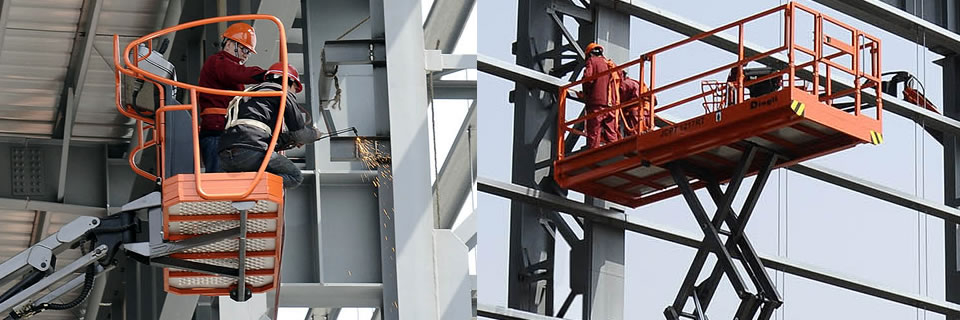
Scissor lifts are mobile elevated work platforms often used in construction, maintenance, and industrial sectors to gain temporary access to elevated areas. They feature a platform raised vertically by linked and folding supports resembling a pair of crossed scissors.
Platform and safety
A scissor lift’s platform provides a safe working area for employees and equipment. Guardrails and toe boards are usually installed for extra safety, and many models come with extended platforms that may support heavier loads or offer extra workspace. Furthermore, scissor lifts have built-in safety features to prevent mishaps, including overload sensors, emergency lowering systems, and safety gates.
Power source
Scissor lifts can be powered by various sources, depending on their surroundings and application. Electric-powered lifts are commonly used indoors or in emission-controlled regions, but diesel-powered lifts, due to their power and longevity, are suited for outdoor or harsh terrain operations.
Applications
These versatile machines are used in a wide range of industries, including construction, building maintenance, installation, repair, and warehouse operations. They offer a solid and efficient platform for accessing overhead locations like ceilings, roofs, and shelving.
Explore the range of scissor lifts available for rent.
Advantages of mast and scissor lift
Mast lifts and scissor lifts have many advantages, so let’s start with scissor lifts.

Access to hard-to-reach areas
Scissor lifts are best suited to construction, maintenance, and warehouse operations. They can reach heights of up to 32 feet, making it easy for employees to access elevated or hard-to-reach areas.Ease of use
These lifts are designed with simple, clear controls to prevent operator fatigue. They don’t require much training, and employees can quickly become proficient.Customisation
Scissor lifts can be customised in order to meet specific requirements. For example, tilters can be added for increased safety, and turntables can be added to allow the platform to rotate, giving them more versatility for a range of activities.
Now, let’s go onto mast lifts.

Access to tight spaces
Vertical mast lifts are small and ideal for reaching elevated heights in narrow, constricted areas. They are suited for jobs in tight spaces like alleyways or between obstructions.Compact and lightweight
Because of their compact size and lightweight, these lifts are easy to store, transport, and manoeuvre. When not used, they even manage to fit in small storage locations such as utility closets.Durability and stability
Vertical mast lifts are made of high-quality aluminium, do not require frequent repairs, and have a long lifespan. They also provide a platform for everyday usage.
Comparing mast lifts and scissor lifts
Here is a comparison between a mast lift and a scissor lift based on key factors:
Height and reach
Mast lifts typically have a wider reach, which makes them ideal for accessing high and narrow spaces. While scissor lifts offer significant height, their reach is usually more constrained than that of mast lifts.
Load capacity and stability
Due to their wider base and crisscross lifting mechanism, scissor lifts have great load capacity and stability, making them perfect for heavy lifting jobs. Mast lifts, on the other hand, are more compact and easier to use in tight spaces but have lower capacity.
Space and mobility
Scissor lifts are more stable and have a greater load capacity. They require more space to operate efficiently. However, Mast lifts are the better choice because of their easier mobility and smaller footprint, requiring employees to manoeuvre through tight spaces.
In summary, based on your operational needs, both mast lift and scissor lift provide unique features and advantages. While mast lifts are excellent for reaching and manoeuvrability in tight areas, soccer lifts offer a high load capability and stability. Choosing the right lift is crucial for maximising efficiency and safety on the job.
At Elavation, we offer a wide selection of mast lifts and scissor lifts so you can discover the perfect solution for your business requirements. Contact us now to discuss your options and improve your operational efficiency and safety.


